

Emissions and energy
The Schwabe Group upholds its responsibility in the field of climate change. The majority of CO2 emissions created worldwide, including our own, result from manufacturing and transporting products as well as from marketing and using them.
Energy conservation and preventing emissions which harm the environment are issues of critical importance; approaches such as decarbonization have an impact here. One particular challenge is to lower the energy consumption of a company even in the face of a rise in the related technical demands (such as those involving manufacturing, storing and transportation).
Conserving energy and using it more efficiently
The Schwabe Group belongs to an industry that is energy-intensive. One reason for this is the high legal standards we as a pharmaceutical manufacturer must fulfill in terms of hygiene. For example, large quantities of filtered air are constantly being moved, warmed and cooled in the course of our manufacturing operations. Our very specific manufacturing conditions do not offer any major options in terms of conserving resources. Furthermore, our extraction processes consume a great amount of energy, and they comply with legal regulations. As a rule, the processes themselves do not offer any great potential for optimization: instead, the objective is to generate energy using different sources and use it as efficiently as possible.
For the same reason, it does not make sense to calculate our carbon footprint on the basis of the products. The hygiene conditions themselves are the largest source of carbon emissions, and they are the same for all products: the CO2 output for each product is the same. If, however, we manufacture large amounts of a product, the CO2 output per unit falls; if we manufacture a smaller quantity at a later point in time, the CO2 output per unit increases, even if the product was not manufactured under “better” or “worse” conditions.
We are convinced that if something is good for the climate, it is good for our company. We very attentively monitor our use of heat and electricity, and already we have successfully been able to reduce usage or find substitutions which prevent emissions. Furthermore, we are optimizing energy efficiency.
Energy-management system at Schwabe
Since July 2025, the energy-management system at the German sites has been certified in compliance with DIN EN ISO 50001. ISO 50001 is an international standard for energy-management systems and defines technical and structural measures to optimize energy-related performance.
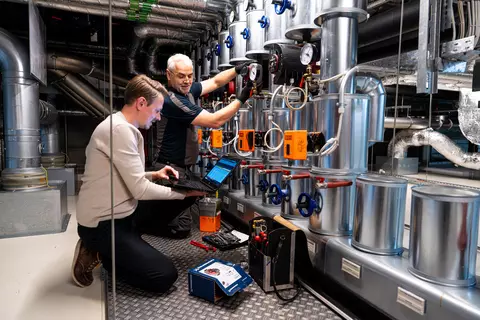
In the annual certification and monitoring audits, a company has to demonstrate that its energy use has improved, i.e. that it has become more energy-efficient.
To achieve this, the Group has to attain greater clarity about its energy consumption and then implement corresponding measures. We will also review and optimize internal processes.
Geothermal project USA
Schwabe North America invested over 12 million USD in a geothermal project. Geothermal energy uses the constant temperature of the earth for efficient heating and cooling. This step means that in the future, the Schwabe Group will emit 850 fewer tons of CO2 per year. To date this is the largest investment in sustainability to have occurred at the Green Bay site. It is scheduled to be complete in 2026.
24% less CO2
The most recent
14% less CO2
The Schwabe Group published its 2022 global carbon footprint for Scope 1 and 2. We reduced our CO2 output by 14% or 6,800 t versus 2021. Having clearly defined areas of action shows us how we can continue to lower our greenhouse gases efficiently.
In 2022, the Schwabe Group successfully reduced CO2 emissions for Scope 1 and 2 in Germany versus the previous year’s figures: down 37% or 6,690 tons!
The Schwabe Group joined forces with Treeo, a start-up that develops methods for
At its German sites, the Schwabe Group converted its fleet of vehicles to electric cars. This way, we benefit twice from the “green energy” we have been purchasing since 2022. For shorter distances, employees can even use one of our e-bikes or public transport.
First global carbon footprint and green electricity
The Group calculated its first global carbon footprint for the year 2021 and Scopes 1 and 2.
The Schwabe sites in Karlsruhe use green electricity from renewable sources for the power we need locally and cannot generate ourselves.
First carbon footprint for German sites
Schwabe publishes its first CO2 footprint for its German sites in 2019 and 2020 and takes immediate action along the supply chain to reduce its footprint.
Schwabe vehicle fleet goes electric
The fleet of vehicles at Schwabe was gradually converted to electric cars by 2023. From 2020, electric bicycles are also available to employees.
Optimisation of chillers
At the Schwabe Strasse power plant, the absorption chillers are replaced by compression chillers. This reduces our footprint by around another 1,800 t CO2 a year.
District heating for DHU
DHU is connected to the municipal district-heating network. The good emission factor of Karlsruheʼs system means that we can prevent releasing around 1,100 t CO2 of emissions a year.
Heat and power plant saves 900 t CO2
At headquarters on Schwabe Strasse, the on-site power plant is updated. The first step is to replace the gas turbine with a combined heat and power plant. This cuts back annual emissions by around 900 t CO2
Solar panels at Terra Medica
At Terra Medica, our center for medicinal plant cultivation, solar panels were installed which generate around 190,000 kWh of electricity per year. A small wind turbine was also installed.
Karlsruhe energy efficiency network
The Schwabe Group joined the Karlsruhe Energy Efficiency Network so that it can work with other regional companies to develop and implement measures that promote energy efficiency.
Our climate goal
Based on the global carbon footprint, we were able to formulate our first major climate goal: By 2030 the Schwabe Group intends to reduce its CO2 emissions in Scope 1 and 2 by 50% in comparison to its baseline year of 2021.
The primary steps here involve the five largest CO2 emitters within the Schwabe Group (the “top 5” countries), especially energy-efficiency measures in the course of developing the site in Germany as well as a geothermal energy project in the US.
There are significant challenges ahead of us, some of which will involve investments. And the Schwabe Group will do its part to reduce its carbon footprint on an ongoing basis. We have already
The Greenhouse Gas Protocol
To calculate our carbon footprint, we follow the general guidelines established in the Greenhouse Gas (GHG) Protocol, an internationally acknowledged standard which allows businesses to report transparently about their emissions.
The GHG Protocol defines three categories, Scopes 1-3. These scopes are designed to provide clarity and to create a distinction between direct and indirect sources of emissions.
Explore Schwabe
A global player with over 150 years of tradition and expertise in herbal medicines and health products.
The Schwabe Group

Entrepreneurial, scientific and pharmaceutical expertise needs experts ... like you!
Your career at Schwabe

We invest around 35 million euros per year in the research and development of phytomedicines.